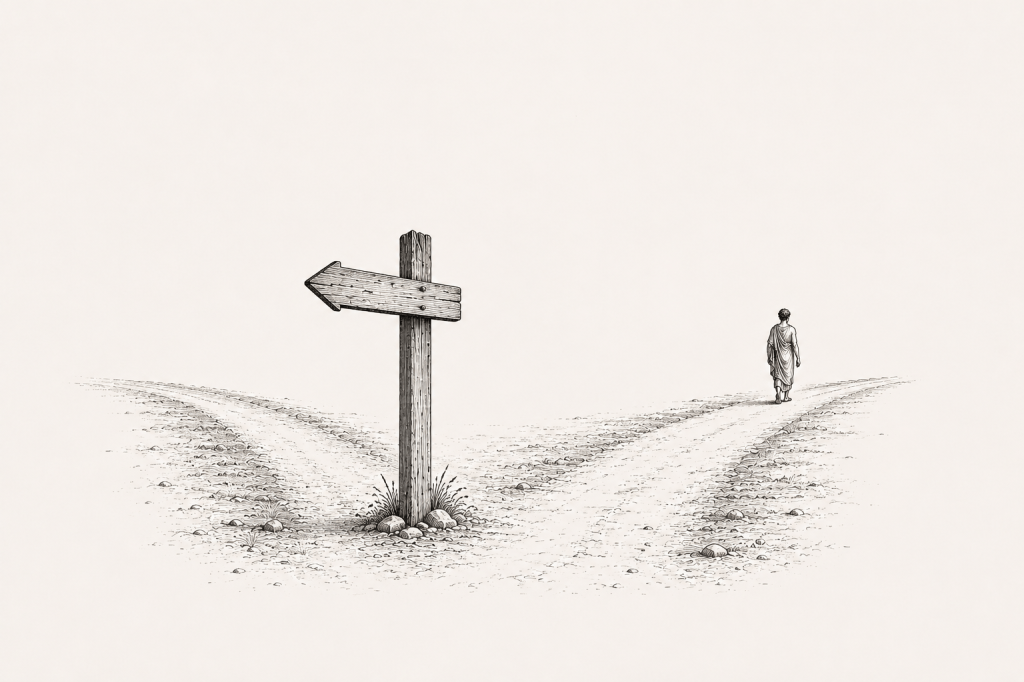
My first attempt at education was a rather unsuccessful one for a couple of different reasons. One of them was that what could have remained a slight dent in my educational path developed into a rather significant curve.
When I read through my primary school reports today, two things become clear. First, I was considered a rather mediocre student. Second, I do not seem to have particularly enjoyed my time at that institution. Whether the former was simply a consequence of the latter is, of course, impossible to prove. But given everything that happened in later years, it no longer strikes me as an implausible explanation.
Personally, I do not remember too many details from my time at primary school. All in all, what I remember most is that I was not particularly focused. I also remember getting into fights rather frequently—resulting in my parents having to pay for the occasional repair of school property. But apart from that, there is not much left.
The problems started later. After primary school, I spent two years at a type of school that no longer exists and that was called the “Orientierungsstufe” (orientation stage). The purpose of these two years was to determine which of the three German school tracks pupils were supposed to follow next: Hauptschule, Realschule, or Gymnasium—only the last of which provides the qualification required for university admission.
In short, this institution was—as its name suggests—supposed to provide orientation. And it did indeed provide some kind of orientation for me, but not quite in the way it was intended to. Because it was during those two years that I first became acquainted with the phenomenon of bullying.
You know, bullying is one of those things that, when they happen to you, never quite stop making you wonder: “Why me?”
For a long time, I was convinced that it was, of course, not my fault. I mean, how could it have been? When an eleven- or twelve-year-old child is being picked on, ridiculed, and humiliated by the majority of the other boys in his class, it can hardly be his fault.
Can it?
But then, on the other hand, social reality is much more complicated than that. Because declaring this younger version of myself completely innocent of everything that happened would, of course, mean declaring all the bullies to be some kind of inherently bad people. And today I do not think that this is true either.
Today, I think it all came down to a mismatch between my behavior and what they considered to be “normal” behavior. Did this give them the right to laugh at me, call me names, and humiliate me? Surely not.
But then, children are just children, after all.
Anyway, because of all these things that together make up the phenomenon of bullying, those two years turned out to be a rather unpleasant experience. I hated going to school. I hated the way to school, I hated the breaks, and most importantly I even hated the classes that I normally would have thoroughly enjoyed.
Because if you are being bullied, you cannot participate in class like everyone else. Anything you say can and will be used against you. So, for the most part, you make use of your right to remain silent.
When I was at home, I spent most of my days alone, watching cartoons or reading comic books. I hardly spent a single minute studying to improve my grades.
It is called escapism, as I know now. Back then, I did not have a word for it, but I really like the descriptive aspect of the term—because it fits very well.
As with everything else on this planet, those years eventually came to an end. As a result of my slight efforts, I once again turned out to be a mediocre student. And accordingly, the teachers decided that I should go to a Realschule rather than a Gymnasium.
Or, in other words—although there are, of course, ways of working one’s way upwards—at the age of twelve it was decided that I would most likely never go to university.
There is one scene which I will never forget. It took place during the final days at this school.
My class teacher, whom I actually liked very much because he taught history, was sitting at his desk handing out the application forms for the local schools. We students were supposed to go up to him and collect the forms for the respective schools.
For what happened next, you need to know that our parents were, of course, not bound by the teachers’ recommendations. They could have sent me to the Gymnasium anyway rather than to the Realschule. Knowing this, I asked my teacher whether I could also have the forms for the Gymnasium.
When I said this, he looked at me and said in a tone of voice that did not try to hide even an inch of his doubt: “You, Jens? To the Gymnasium?”
From that moment onwards, I liked him considerably less.
All my bullies were, of course, sent to the Gymnasium without question. What is interesting, though, is that, to the best of my knowledge, none of them went into higher education afterwards. If my information is correct, every single one of them completed a rather mediocre Abitur and decided to stay in our small hometown or the surrounding area.
But the fact that they went to a different school than I did also had something positive to it. Because it gave me a fresh start.
This is the point where we come back to the orientation that this orientation stage actually provided for me. Because I still remember that I actively decided back then that I would never let something like this bullying happen to me again.
But how can you avoid something like that?
Well, that is easy.
You just adapt to the bullying.
I never became a bully myself, though. To be honest, I am quite capable of picking on people, but only for two different reasons.
The first is that I actually like them a lot. I mean, what is more enjoyable than that slight friction that comes with a friendly tease when both people feel emotionally completely safe?
The second is that they have given me a considerable reason…
But I could never pick on someone in a cruel way just for the fun of it. And it never became clear to me how anyone can.
Anyway, what I meant by “you adapt to the bullying” is something different. I meant that from then on I tried to behave like “the cool kids”. I tried to find my place among those people in my class who would never be picked on.
And what can I tell you? I succeeded rather well.
But there was a problem with this approach. The “cool kids” are seldom the best students in class. They are the ones who, with every inch of their being, want to be considered above such things as grades and homework.
Or, in short, the “cool kids” in this particular school were definitely not the ones who worked their way upwards to the Gymnasium.
It was in this way that the slight dent which the bullying could have been developed into a not insignificant curve in my educational path.
But then, there is also another aspect to this, which relates to me being a First-Generation Academic: If you lack role models in your family, it becomes much harder to resist such forces.
My parents, even though—or perhaps because—they are very good people, never put much pressure on me regarding my grades or my educational development in general. When I brought home a bad mark, their reaction was more or less the same as when I brought home a good one. And when the teachers decided to send me to the Realschule, they never questioned that decision.
We hear so much today about parents and educational systems putting too much pressure on children. And, of course, pressure can be a very bad thing.
But, on the other hand, a bit of the right pressure can also provide orientation. And orientation, I think, is not a bad thing. Because everyone needs it. If it is not provided by the people and institutions that are supposed to provide it, children will eventually find it on their own.
But since children are just children, they may very well be guided by the wrong impulses.
 Jens Fischer
Leave a Note